Nepal vision | 23/07/2026
The Manaslu Circuit suits trekkers who want a quieter, more remote, and more demanding restricted-area trek with a mandatory guide, while the Annapurna Circuit suits those who want a longer, more varied, and slightly more accessible classic route with well-established teahouses throughout. With Nepal Vision Treks, the 17-day Manaslu Circuit costs from US$2,280 per person, and the 21-day Annapurna Circuit costs from US$2,490 per person, both fully inclusive.
Both treks circle an 8,000-metre giant. Both cross a high mountain pass above 5,000 metres. Both rank among the finest circuit treks anywhere in the Himalayas, and both regularly appear on "best treks in Nepal" lists compiled by people who have walked most of the country's trails. Yet they differ substantially in remoteness, regulation, crowd levels, and the overall character of the trekking experience. Choosing between them, or working out which to do first if you plan on doing both eventually, deserves more than a glance at a map. This guide goes deep into every factor that should influence your decision: cost, difficulty, permits, culture, food, teahouses, best months to go, and what each trek actually feels like underfoot.
A Quick Comparison
Factor | Manaslu Circuit Trek | Annapurna Circuit Trek |
| Duration with Nepal Vision Treks | 17 days | 21 days (16-day option also available) |
| All-inclusive cost from Nepal Vision Treks | US$2,280 per person | US$2,490 per person (16-day from US$2,190) |
| Maximum altitude | 5,135m at Larkya La Pass | 5,416m at Thorong La Pass |
| Difficulty grade | Hard | Medium |
| Guide requirement | Mandatory, restricted area permit required | Not legally mandatory, strongly recommended |
| Permits needed | Manaslu Restricted Area Permit, Manaslu Conservation Area Permit, Annapurna Conservation Area Permit | Annapurna Conservation Area Permit, TIMS card |
| Start and end point | Kathmandu, via Soti Khola | Kathmandu, via Besisahar, finishing in Pokhara |
| Crowd levels | Low, capped by restricted-area regulation | Moderate to high, one of Nepal's most popular circuits |
| Teahouse standard | Basic to improving, especially above Namrung | Good to excellent, the most developed circuit trail in Nepal |
| Best seasons | March to May, September to December | March to May, September to December |
| Signature experience | Remote Nubri and Tsum valleys, close-up Manaslu views | Kali Gandaki Gorge, Poon Hill sunrise, Muktinath temple |
| Best suited for | Experienced trekkers wanting solitude and a real challenge | Trekkers wanting a longer, varied, well-supported classic circuit |
The Case for the Manaslu Circuit Trek
A genuinely remote, restricted-area experience
The single fact that shapes everything about the Manaslu Circuit is its legal status. The section of trail running from Jagat to Bimtang sits inside a government-designated restricted area, which exists to protect the region's fragile ecology and its Tibetan-influenced culture from the kind of uncontrolled tourism growth that transformed parts of the Everest and Annapurna regions over the past three decades. Because of this designation, every trekker must travel with a licensed guide, and independent solo trekking is not permitted.
The practical result is a trail that stays noticeably quieter than almost anywhere else in Nepal at a comparable altitude and scenic quality. Where the Annapurna Circuit can see dozens of trekkers converging on the same teahouse during peak season, Manaslu rarely feels crowded even in October and November, historically the busiest months for Himalayan trekking. For anyone who has trekked Everest Base Camp or Annapurna Base Camp and found the queues at viewpoints or the packed dining rooms at altitude a little dispiriting, Manaslu offers something closer to what those treks might have felt like twenty years ago.
Closer, more dramatic mountain views
Because the Manaslu Circuit stays tucked into the narrow Nubri Valley for most of its length, the trail delivers close-up, almost intimate views of Mount Manaslu (8,163m), Himalchuli, Ngadi Chuli (also called Peak 29), and Ganesh Himal. This contrasts with the wider, more distant panoramas typical of much of the Annapurna Circuit, where the mountains, while still enormous, are often viewed from across broader valleys.
The approach to Larkya La is one of the more visually dramatic high-altitude crossings in Nepal trekking. From Samdo, the trail climbs past the Larkya Glacier and its tumbling icefall, with Manaslu, Manaslu North, Naike Peak, and Cheo Himal rising on either side. Reaching the top of the pass, prayer flags snapping in the wind, with Annapurna II visible in the far distance to the west, is the kind of moment that keeps trekkers coming back to this region.

A harder trek, by Nepal Vision Treks' own grading
Nepal Vision Treks grades the Manaslu Circuit as Hard and the Annapurna Circuit as Medium. This is worth sitting with for a moment, because it runs slightly against intuition: Larkya La, at 5,135m, is actually lower than Annapurna's Thorong La, at 5,416m. So why is Manaslu graded harder?
The answer comes down to a combination of factors beyond raw altitude. The lower Nubri Valley involves steep, exposed sections of trail, particularly between Machha Khola and Namrung, where landslide-prone terrain and narrow cliffside paths demand more sustained concentration than the gentler gradients typical of lower Annapurna. Trail conditions are generally less maintained, since fewer trekkers and less commercial pressure mean less investment in path infrastructure. And critically, the psychological and logistical demand of trekking through more isolated country, with fewer rescue points, less frequent teahouses, and greater distance between settlements, adds a layer of difficulty that a simple altitude comparison misses entirely.
None of this should discourage a reasonably fit trekker. It simply means Manaslu rewards those who come prepared, both physically and mentally, for a wilder experience than the standard Annapurna teahouse circuit.
Culture centred on Tibetan Buddhist heritage
South of Namrung, the Manaslu Circuit passes through villages with a mixed Gurung and Hindu-influenced character, not unlike lower Annapurna. But above Namrung, the region turns unmistakably Tibetan. Villages such as Lho, Shyala, and Samagaon are built around monasteries and chortens, their houses arranged in the compact, stone-walled style typical of Tibetan plateau architecture. Mani walls, carved with Buddhist prayers, line the trail for kilometres, and trekkers are expected to pass them on the left, in the traditional clockwise direction of circumambulation.
Samagaon itself sits beneath Manaslu's southern face and is one of the most atmospheric villages on any trek in Nepal, with its own monastery, a resident population that still herds yaks in the high pastures, and views that rival anything on the Everest side of the country. For trekkers who want their Himalayan trek to double as an immersion in Tibetan Buddhist village life, rather than the more Hindu-Buddhist blend typical of Annapurna, Manaslu is consistently the more rewarding choice.
Trade-off: shorter teahouse season and rougher facilities
None of this comes without cost. Manaslu's teahouses, while improving every season as the region opens up further, are still noticeably more basic than Annapurna's, particularly above Samagaon. Hot showers become unreliable and sometimes unavailable. Menus narrow to a fairly standard rotation of dal bhat, noodles, and basic fried dishes. Wifi, where it exists at all, is patchy and often charged separately. Trekkers who place a high value on creature comforts during a multi-day trek should weigh this trade-off seriously before committing to Manaslu over Annapurna.
The Case for the Annapurna Circuit Trek
The most complete trekking experience in Nepal
At 21 days with Nepal Vision Treks, the Annapurna Circuit covers more ground and passes through more distinct climate zones than almost any other trek in the country. It begins in the subtropical lowlands near Besisahar, climbs through pine and rhododendron forest around Chame and Pisang, crosses into the high, arid, almost Tibetan-plateau-like landscape around Manang and Yak Kharka, summits at Thorong La, then descends through the Kali Gandaki Gorge, the deepest gorge in the world when measured from the peaks on either side to the riverbed below. From there it continues through Marpha's apple orchards, Tatopani's natural hot springs, and finally up to Ghorepani for the famous Poon Hill sunrise before dropping to Pokhara.
Few single treks anywhere in the world pack in this much ecological, cultural, and scenic variety. Trekkers regularly describe the Annapurna Circuit as feeling like several different treks stitched into one itinerary, and for many, that variety is precisely the appeal.

No restricted-area guide requirement
Unlike Manaslu, the Annapurna Circuit runs entirely through the Annapurna Conservation Area rather than a government-restricted zone, which means a guide is not legally required. In practice, Nepal Vision Treks strongly recommends trekking with a guide regardless, for safety in changeable mountain weather, for navigation on the less obvious sections of trail, and for the cultural insight a good guide brings to village life along the way. But the legal flexibility to trek independently, for those with genuine prior high-altitude experience and strong self-sufficiency, remains a real point of difference between the two regions, and one that some experienced trekkers specifically value.
The Annapurna Conservation Area's mature infrastructure
Decades as Nepal's single most popular trekking region have built out Annapurna's teahouses far more thoroughly than anywhere else in the country, Everest included in many respects. Hot showers, varied food menus that stretch well beyond the standard dal bhat, and reliable wifi are common even at higher elevations such as Manang and Muktinath. Over a 21-day trek, this matters more than it might on a shorter trip. Small comforts compound over three weeks, and having a hot shower after a long climbing day, or a proper bakery item in Marpha, genuinely lifts morale in a way that becomes noticeable by the second week.
A slightly lower technical difficulty
As already noted, Nepal Vision Treks grades the Annapurna Circuit as Medium against Manaslu's Hard, largely thanks to better-maintained trails, more frequent teahouses for rest and resupply, and a well-established acclimatisation rhythm built around the extended stop in Manang. Thorong La, at 5,416m, is the higher of the two passes and the crossing day itself is genuinely demanding, typically 7 to 8 hours of walking with a significant early-morning start. But the surrounding infrastructure, familiar routine, and predictable trail conditions make the overall trek more manageable for a broader range of fitness levels than Manaslu.
The Poon Hill and Muktinath bonus
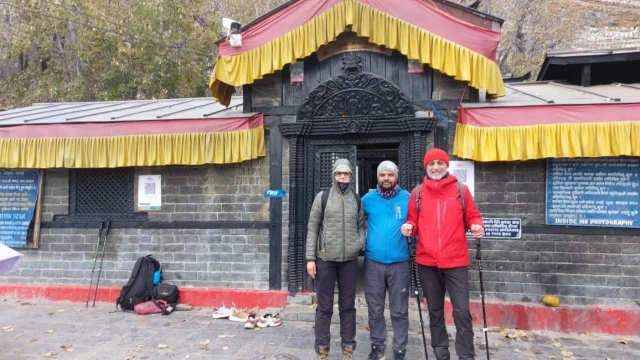
The Nepal Vision Treks itinerary for the Annapurna Circuit tacks on a Ghorepani-Poon Hill detour near the end of the trek, along with a visit to the sacred Muktinath temple, both entirely absent from the Manaslu route. Poon Hill's sunrise panorama, taking in Dhaulagiri, Annapurna, Machhapuchhre, and on clear days peaks as far as Manaslu itself, is one of the most photographed viewpoints in Nepal for good reason. Muktinath, meanwhile, is a genuinely significant pilgrimage site for both Hindus and Buddhists, drawing devotees from across the subcontinent and Tibet, and visiting it adds a spiritual and cultural dimension that pairs naturally with the trek's physical demands.
For trekkers who want a single trip that combines high mountain panoramas, a major pilgrimage site, and one of Nepal's most celebrated sunrise viewpoints, this combination is genuinely hard to match anywhere else in the country.
Trade-off: busier trails
Annapurna's popularity is, inevitably, a double-edged sword. Peak season weeks in October, November, March, and April bring noticeably more trekkers to the trail, fuller teahouses that sometimes require booking to guarantee a room, and considerably less solitude than Manaslu offers at any point in the year. Trekkers who prioritise a quiet, contemplative experience over variety and infrastructure should factor this in carefully, and consider shoulder-season dates if crowds are a genuine concern.
Cost Comparison: What You Actually Pay
Nepal Vision Treks publishes all-inclusive pricing for both routes, covering permits, a government-registered guide, a porter shared between two trekkers, teahouse accommodation throughout the trek, full board meals (breakfast, lunch, dinner, tea and coffee), Kathmandu hotel nights with breakfast, airport transfers, a welcome and farewell dinner, and all necessary paperwork.
Manaslu Circuit Trek, 17 days: from US$2,280 per person. This covers the Manaslu Restricted Area Permit, the Manaslu Conservation Area Permit, and the Annapurna Conservation Area Permit, the last of which is required because the final stretch of the route, through Tilje and Chamje, technically crosses into Annapurna Conservation Area territory before the drive back to Kathmandu via Besisahar. It also includes a government-registered, English-speaking, first-aid and eco-trained trek guide, and a Sherpa porter shared between two trekkers, along with seasonal sleeping bags, a Nepal Vision Treks duffel bag, and a trekking map.
Annapurna Circuit Trek, 21 days: from US$2,490 per person. This covers the Annapurna Conservation Area Permit and TIMS card, guide, and shared porter, along with the same standard of teahouse accommodation, full board trekking meals, and Kathmandu hotel nights. A shorter 16-day version of essentially the same route, with a slightly more compressed itinerary, is also available from US$2,190 per person for trekkers with less time available.
At first glance, the higher relative cost of Manaslu for a shorter trip, US$2,280 across 17 days versus US$2,490 across 21 days for Annapurna, might look counterintuitive. But it reflects the additional restricted-area permit fees, which are a fixed government charge on top of standard conservation area fees, and the higher logistical cost of supplying food, fuel, and staff wages to a genuinely remote region with fewer road links than the Annapurna corridor enjoys.
What is not included in either package is worth noting clearly for budgeting purposes: international airfare to and from Kathmandu, Nepal visa fees (typically paid in cash on arrival at Tribhuvan International Airport), travel and rescue insurance, lunch and dinner in Kathmandu outside the welcome and farewell dinners, any extra nights of Kathmandu accommodation caused by early arrival, late departure, or an early return from the mountain, and personal expenses such as bottled water, snacks, hot showers where charged separately, battery charging, and tips for guides and porters.
Trekkers who want to extend the Manaslu trip further can combine it with the Tsum Valley, a culturally rich side valley branching off the main Manaslu trail that remains one of the least-visited regions in Nepal, offering an even deeper dive into Tibetan Buddhist village life for those with additional time.
Difficulty and Altitude: A Closer Look
Both treks cross a mountain pass above 5,000 metres, and altitude sickness risk exists on both routes if acclimatisation days are skipped or rushed. A few specific points are worth understanding before deciding between them.
Larkya La (Manaslu) sits at 5,135m. The approach from Samdo through Larkya Phedi to the pass, and the long descent on the far side to Bimtang, forms a single demanding day, typically 7 to 8 hours of walking, with genuinely limited bail-out options once committed. There is no shortcut back down if weather turns or altitude symptoms worsen partway across; trekkers are largely committed to completing the crossing once they set off from Larkya Phedi in the pre-dawn cold.
Thorong La (Annapurna) sits higher, at 5,416m, making it technically the more extreme altitude of the two passes. However, the well-worn trail, frequent teahouses at Yak Kharka and Thorong Phedi in the days leading up to the crossing, and the established, near-mandatory acclimatisation stop at Manang give trekkers considerably more margin for error. The Himalayan Rescue Association operates a post in Manang specifically to monitor and advise trekkers on altitude sickness during the Annapurna season, a resource with no direct equivalent on the Manaslu route.
Nepal Vision Treks builds a dedicated acclimatisation day into both itineraries: at Samagaon (3,530m) on the Manaslu route, and at Manang (3,500m) on the Annapurna route. This day is not a luxury add-on; it is essential for either trek regardless of a trekker's prior experience or general fitness level, since altitude sickness is governed far more by ascent rate than by fitness. Skipping or shortening these acclimatisation stops, even for very fit trekkers, meaningfully increases the risk of acute mountain sickness.
For a first high-altitude circuit trek, Annapurna's infrastructure, established rescue resources, and gentler official grading make it the more forgiving introduction to trekking above 5,000 metres. For trekkers who have already completed Everest Base Camp or Annapurna Base Camp and are looking for a genuine step up in both remoteness and physical demand, Manaslu is the natural next challenge, and one that experienced Nepal trekking guides consistently recommend as a second or third Himalayan trek rather than a first.
Teahouses, Food, and Daily Comfort
The lived, day-to-day experience of these two treks differs more than the statistics alone suggest. On the Annapurna Circuit, particularly through Chame, Pisang, Manang, and down through Marpha and Tatopani, teahouses commonly offer attached bathrooms, solar-heated or gas-heated hot showers, extensive menus running to pizza, momos, pancakes, and even the occasional bakery item, alongside the trekking staple of dal bhat. Wifi is widely available, usually for a small daily fee, and charging points for phones and cameras are standard, again often at a small cost per device.
On the Manaslu Circuit, particularly north of Namrung through Lho, Shyala, Samagaon, and Samdo, facilities step down noticeably. Shared bathrooms are more common than attached ones. Hot showers, where available, are often bucket showers rather than proper plumbed systems, and may carry an additional charge. Menus are simpler, generally built around dal bhat, noodle soup, fried rice, and basic egg dishes, with less variety than Annapurna offers at comparable altitudes. Wifi exists in some of the larger villages such as Samagaon but should not be relied upon.
Neither of these facts should be read as a reason to avoid Manaslu. Many trekkers specifically seek out the simpler, more traditional teahouse experience precisely because it feels closer to what trekking in Nepal was like before the Annapurna and Everest regions became as commercially developed as they are today. But trekkers who have specific comfort requirements, whether for health reasons or simple preference, should factor this difference into their decision with open eyes.
Best Time to Trek Each Route
Both treks share broadly the same optimal seasons: March to May for spring, and September to December for autumn and early winter. Within those windows, some nuance is worth understanding.
Spring (March to May) brings warming temperatures, blooming rhododendron forests at lower elevations on both treks, particularly striking on the lower Annapurna Circuit route and the lower Manaslu approach through Machha Khola and Jagat, and generally stable weather, though afternoon cloud build-up is common as the season progresses towards May.
Autumn (September to November) is widely considered the single best season for both treks, offering the clearest mountain visibility of the year following the monsoon's washing effect on dust and haze, combined with stable, dry weather patterns. This is also, unsurprisingly, the busiest season on both routes, though the effect is far more pronounced on Annapurna than on Manaslu, where restricted-area trekker caps keep numbers naturally lower even at peak times.
Early winter (December) remains viable on both treks, particularly earlier in the month, though both Larkya La and Thorong La become significantly more difficult and occasionally impassable later in the season due to heavy snowfall, and teahouses at higher elevations on both routes begin closing for the winter as trekker numbers drop.
Monsoon (June to August) is not recommended for either trek. Heavy rainfall brings landslide risk on both routes, particularly on the lower, less-engineered sections of the Manaslu trail, along with leeches, obscured mountain views, and a generally miserable trekking experience that most operators, Nepal Vision Treks included, advise against.
Fitness, Training, and Preparation
Both treks demand a solid baseline of cardiovascular fitness and several consecutive days of sustained walking capacity, typically 5 to 8 hours per day carrying a daypack, but Manaslu's Hard grading against Annapurna's Medium grading should translate into a meaningfully more serious training approach for anyone choosing the former.
For either trek, a training programme beginning at least eight to twelve weeks before departure, combining regular hiking with elevation gain where possible, general cardiovascular conditioning such as running, cycling, or swimming, and some strength work focused on legs and core, will make a substantial difference to how the trek feels on the ground. Trekkers preparing specifically for Manaslu should place additional emphasis on back-to-back long walking days in training, simulating the sustained demand of the trek's less forgiving daily walking hours, particularly in the lower Nubri Valley where days of 6 to 7 hours of walking are common even before altitude becomes a significant factor.
Previous high-altitude experience, even at more modest elevations such as a prior trek to Everest Base Camp, Annapurna Base Camp, or a comparable trek elsewhere in the world above 4,000 metres, is a meaningful asset for either trek, but particularly for Manaslu, where the more limited teahouse network and rescue infrastructure mean trekkers benefit from already understanding their own body's response to altitude before attempting the more demanding route.
Which Trek Should You Choose?
Choose the Manaslu Circuit if you want a quieter, wilder, restricted-area trek with close-up Himalayan views, a strong Tibetan Buddhist cultural thread, and you are comfortable trading some teahouse comfort for solitude and a genuinely harder physical and logistical challenge. It particularly suits trekkers who have already completed at least one major Himalayan trek and are looking for the next step up.
Choose the Annapurna Circuit if you want the single most complete trek available in Nepal, covering the widest range of landscapes, climate zones, and culture in one continuous route, with better-developed teahouses, a slightly gentler official difficulty grade, and the option to add Poon Hill and Muktinath into the same trip. It particularly suits trekkers doing their first major high-altitude circuit trek, or those who simply want maximum variety across three weeks in the mountains.
Many experienced trekkers eventually do both, and there is no requirement to choose only one for a lifetime of Nepal trekking. If you have already completed Annapurna Base Camp or the full Annapurna Circuit and are looking for what comes next, Manaslu is consistently the trek that Nepal Vision Treks' guides recommend as the natural progression, offering a genuine step up in remoteness and challenge without requiring an entirely different order of technical mountaineering skill.
Ready to choose your circuit? Explore the Manaslu Circuit Trek or the 21-day Annapurna Circuit Trek on nepalvisiontreks.com, or get in touch with the team to talk through which route fits your fitness level, budget, and time in Nepal.
Frequently Asked Questions