Nepal vision | 27/07/2026
For trekkers who already have high-altitude trekking experience in Nepal and want their first proper peak climb, Mera Peak is generally the better starting point. It reaches a higher summit at 6,476m but demands less technical rope and ice skills than Island Peak, which sits lower at 6,189m yet involves a steeper, more exposed, and more technically demanding summit day. With Nepal Vision Treks, the 15-day Mera Peak Climb costs from US$2,690 per person, and the 16-day Island Peak Climb costs from US$2,475 per person.
Both peaks sit firmly in Nepal's "trekking peak" category, meaning they're climbable without a full mountaineering expedition's worth of technical training, and both are genuinely popular first climbs for trekkers stepping up from Everest Base Camp or Annapurna Base Camp. But they test different things, and choosing the wrong one for your actual skill gap can turn what should be an exciting progression into an unnecessarily stressful summit day. This guide breaks down exactly where the two differ, using Nepal Vision Treks' own itineraries and pricing, so you can pick the climb that matches the skills you actually need to build next.
Mera Peak vs Island Peak at a Glance
Factor | Mera Peak (15 Days) | Island Peak (16 Days) |
| Summit altitude | 6,476m, Nepal's highest trekking peak | 6,189m |
| Cost from Nepal Vision Treks | US$2,690 per person | US$2,475 per person |
| Difficulty grade | Hard | Hard |
| Technical demand | Snow slope walking, basic crampon and ice axe use, rarely steeper than 40° | Rock gully, roped ridge traverse, glacier crossing with crevasses, 40 to 45° ice slope near the summit |
| Tented nights | One, at Mera High Camp only | Two, at Island Peak Base Camp before and after the summit push |
| Acclimatisation stops | Namche-style villages plus a dedicated acclimatisation and pre-climb training day at Khare | Namche Bazaar and Dingboche, each with a built-in acclimatisation day |
| Approach region | Remote Hinku Valley, quieter trails, fewer trekkers | Standard Everest Base Camp corridor via Namche and Dingboche, then a short detour to Chhukung |
| Summit day character | Long, steady snow walk to a broad summit dome | Short scramble, exposed ridge, glacier travel, fixed-rope ice pitch |
| Best suited for | Climbers who've proven they can handle altitude and want a gentler introduction to basic mountaineering technique | Climbers who specifically want technical rope and ice experience as a stepping stone to harder peaks |
Why Mera Peak Is the Better First Climb for Most Trekkers
It tests what you've already trained for, not something new
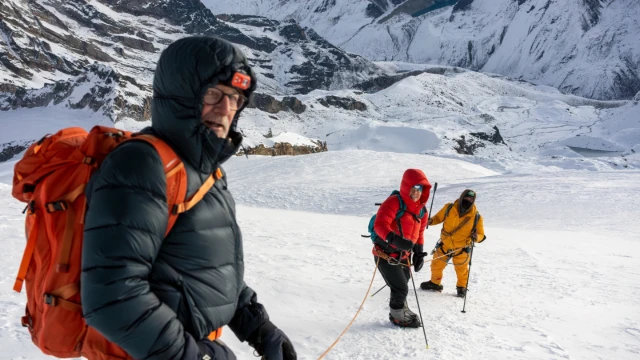
If your Himalayan experience so far is Everest Base Camp, Annapurna Base Camp, or a comparable trek, what you've proven is that you can handle sustained altitude, long walking days, and cold. Mera Peak asks for more of exactly that. The summit push from Mera High Camp is a long day, but it's fundamentally a very steep, very high snow walk on a rope team, not a technical climb in the sense of steep ice or exposed scrambling. Nepal Vision Treks' own route rarely exceeds a 40° snow slope on the way up, which is well within reach of a fit trekker who's had a day of proper instruction.
The itinerary builds your skills before it tests them
This is the detail that matters most for a genuine first-timer. Nepal Vision Treks schedules a dedicated acclimatisation and pre-climb training day at Khare (day 9 of the 15-day itinerary) specifically to teach crampon technique, ice axe use, and rope team movement before you're anywhere near the summit slope. You're not learning these skills under pressure on summit day; you're learning them the day before, at a lower, safer camp, with time to practise and ask questions.
Only one tented night
Nepal's teahouse network is genuinely one of its underrated luxuries, and Mera's itinerary uses it almost the entire way. You're only in a tent for a single night, at Mera High Camp immediately before the summit push. Every other night of the trek is spent in a teahouse with proper food, a roof, and some shelter from the wind. This matters more than it sounds on a climb where fatigue and cold both compound quickly.
Trade-off: it's a longer, more remote approach
Reaching Mera means several days through the quieter Hinku Valley, away from the busier Everest corridor. This is a genuine selling point for trekkers who want solitude, but it also means longer daily walking distances in the approach and less familiar infrastructure than the well-trodden Namche-Tengboche-Dingboche route most EBC trekkers will already recognise.
Why Island Peak Suits a Different Kind of First-Timer
It's the more technical climb, despite the lower summit
Island Peak's 6,189m summit is nearly 300m lower than Mera's, but don't let that fool you into thinking it's the easier climb. The final push involves a rock gully scramble to start, a roped traverse along an exposed section of ridge, a glacier crossing where crevasse hazard is real enough that the entire group moves roped together, and a genuinely steep 40 to 45° ice slope near the top where your guide fixes rope for the final approach. If you specifically want to learn glacier travel, rope work, and steep ice technique, this is a far better teacher than Mera.
It follows the route you may already know
Island Peak's approach runs through Namche Bazaar, Tengboche, and Dingboche, the same corridor used by the standard Everest Base Camp Trek, before branching off to Chhukung and the peak itself. If you've already trekked to EBC, a meaningful chunk of this itinerary will feel familiar, which can be a genuine confidence boost heading into the harder technical section.
Trade-off: two tented nights around the hardest part of the trip
Nepal Vision Treks' itinerary has you camping at Island Peak Base Camp both the night before and the night after your summit attempt, meaning your two most physically demanding days both bracket a night in a tent rather than a teahouse. Combined with the technical demands of the climb itself, this makes Island Peak the more physically and logistically taxing option overall, even though the altitude gain is smaller than Mera's.

Cost Comparison
Using Nepal Vision Treks' own current pricing: the 15-day Mera Peak Climb costs US$2,690 per person, and the 16-day Island Peak Climb costs US$2,475 per person, a difference of US$215 despite Mera being one day shorter. Both prices include permits, a government-registered climbing guide, a shared Sherpa porter, full board meals, teahouse or tented accommodation as the itinerary requires, and standard Kathmandu hotel nights with breakfast.
Neither price includes climbing gear rental (crampons, harness, ice axe, plastic mountaineering boots), which most trekkers rent in Kathmandu rather than buy outright for a single climb, nor does it include international airfare, visa fees, travel and rescue insurance, or Lukla-related costs beyond what's built into the standard itinerary.
The modest price difference doesn't track neatly onto difficulty. Mera's cost reflects its longer, more remote approach through the Hinku Valley and one additional trekking day; Island Peak's lower cost reflects its shorter overall itinerary and the fact that much of its early route overlaps with well-established EBC infrastructure, even though the summit day itself is more technically demanding.
Which Skills Are You Actually Trying to Build?
This is the honest question worth answering before booking either climb, and it matters more than the summit altitude on the brochure.
Choose Mera Peak if what you want next is confirmation that you can handle a genuine high-altitude summit push, with basic mountaineering skills taught properly beforehand rather than assumed. It's the better choice if your priority is altitude and endurance over technical climbing, and if you'd rather spend as many nights as possible in a teahouse rather than a tent.
Choose Island Peak if you specifically want exposure to roped glacier travel, steep ice technique, and an exposed ridge traverse, skills that matter if you're eyeing something like Lobuche Peak, Ama Dablam, or eventually an 8,000m expedition further down the line. It's the better technical training ground precisely because it doesn't hold your hand the way Mera's gentler snow walk does.
Neither peak requires prior technical climbing experience to attempt with a qualified guide, but Island Peak rewards at least some prior comfort with exposure and steep terrain far more than Mera does. If you're not sure which category you fall into, Mera is the safer first choice; you can always use it as the platform to attempt Island Peak, or something harder, the following season.
Ready to plan your first peak climb? Explore the Mera Peak Climb, 15 Days or the Island Peak Climb, 16 Days, and get in touch with Nepal Vision Treks to talk through which climb matches the skills you actually want to build next and reach out to our travel expert at +977 9802342081 or [email protected]
Frequently Asked Questions