Nepal vision | 13/04/2026
The first thing that comes to the mind of the majority of trekkers when they hear Nepal is the overcrowded trails to Everest Base Camp or the old trail to the Annapurna Circuit.
But go farther into the rain-shaded valleys of the Manang District, and you will find something deeper still, Nar and Phu, two villages that live in another world altogether, where old Tibetan manners still beat their time in the daily round, and modernity is treading softly on the heels of centuries-old customs.
You are an adventure traveler, and you are not only in search of breathtaking scenery and hiking paths. You desire to touch something that is real, something not touched. Nar and Phu provide just that, a breathing, living window into a culture that has managed to retain its soul despite the 21st century knocking on its door.
Where Is Nar & Phu Valley? A Hidden Himalayan Sanctuary
Nar and Phu are not mere fortuitous finds, being located high above 4000 m in the extreme northeastern region of the Manang District of Nepal. They are the result of geographical seclusion and planned cultural protection. The rocky path of Koto cuts through uncompromising land, and this seclusion is no chance thing; it has been the magic kept these valleys.
The culture of these villages is even reflected in the landscape. Rocky faces rise above the passes that have been hit by the wind, and the scenery is stretched to snow-covered peaks such as Kanguru Himal and Himlung. The terrain is harsh, almost forbidding. But the inhabitants of this place are not settlers, attempting to make the land their own-they are the descendants of Tibetan peoples who realized that being here meant being a part of the land, not its conqueror.
This geography has a great cultural implication for adventure trekkers. Every step you take follows in the footsteps that have been walked these same paths for generations. The paths are not roads, but tales written in the ground.
The Tibetan Roots of Nar Phu Valley Culture
This is what is so extraordinary about Nar and Phu: the people are not museum displays who are playing their culture to the tourists. Life goes on just like it did centuries ago, with its rhythms dictated by seasons, weather, and Buddhist calendars instead of market forces.
The societies here, which are mostly descendants of Tibetan settlers and also harbor other ethnic groups such as the Lama, Ghale, and Gurung, have a different cultural identity that is hardly experienced in modern Nepal. Being united in terms of the population of only a few hundred people, these villages are not destinations, rather an extended family, which opens its doors to you and invites you to join their small world.
Another cultural preservation layer is that the local language, the Nar-Phu dialect, is significantly impacted by classical Tibetan. When native people converse with one another, they are preserving linguistic continuity, which goes back hundreds of years. To trekkers, this language barrier is not an annoyance- it is a sign of authenticity. You are in an environment that has not sold out to the mall or business.

Spiritual Life in Nar & Phu: Tibetan Buddhism in Practice
Stroll around Nar and Phu, and you are instantly struck by something that most contemporary towns have faded away: spirituality is not a Sunday morning and a religious edifice. It is interwoven with all the moments of life.
The flags of prayer are seen everywhere, not as a tourist attraction but as a form of spiritual practice. Mani walls, ancient stones carved with sacred mantras, line the paths. The prayer wheels are turning, pushed by the hands of people and by the wind currents, with every turn, a whisper into the universe. Chortens (Buddhist monuments) are places that guard village entrances, where sacred boundaries separate the secular from the spiritual.
The communities practice a distinctive combination of the Kagyu and Nyingma schools of Tibetan Buddhism, teachings that emphasize meditation, kindness, and the guidance of enlightened masters. This is not Buddhism as a religion practiced once a week: it is a whole system of interpreting the world of existence and the role of man in it.
Sacred Monasteries of Nar & Phu Valley
This spiritual terrain is anchored by two holy monasteries:
The Monastery of Tashi Lhakhang in Phu is thought to be more than 700 years old, a worn-out guardian that has seen centuries of rituals, prayers, and monastic teachings. When you stand in front of its old walls, it is not only that you are looking at a building, but you are feeling history with your eyes.
Nar Phedi Monastery, a small monastery with a small community of devout nuns, located beneath Nar village, offers the chance to visit and stay to experience monastic life firsthand. You could imagine waking up to the rhythm of the chanting of the dawn prayers, the actual spiritual practice of the Buddhist nuns, not to watch it with your eyes.
This spiritual intensity can alter even the adventure trekkers who are used to secular mountaineering. It is said that a visit to these monasteries has a lasting impact on how they view mountains, and that this explains why people give their lives to spiritual cultivation in such harsh conditions.
Festivals of Nar Phu Valley: When Culture Comes Alive
It is as though you have discovered a backdoor into the heart of a culture when you plan your hike to fall at festival time. The Nar Phu calendar is characterized by two major celebrations that reveal the community's most important values.
Losar: Tibetan New Year (End of January)
The most anticipated festival of the year is Losar, and justifiably so. When this festival comes at the end of January, all the valley changes. The locals wear their best handwoven clothes- complex fabrics which symbolize many years of weaving practice and the skills of artisans.
During Losar, you'll witness:
- Prayers and Offerings: Communities assemble in courtyards and monasteries to pray at dawn and make offerings to the deities to receive blessings for the forthcoming year.
- Masked Dances: The performers are dressed in colorful costumes and masks of various spiritual beings, and they perform mythological stories that are both educational and entertaining.
- Fire Rituals: Holy fires are lit as cleansing ceremonies, and the smoke is used to pray to the heavens.
- Lavish Feasts: Group meals celebrate their survival through another terrible year and reinforce the ties that hold these small communities together.
Yartung Festival: Wild Celebration of the Summer (July-August).
Summer, when the high passes are finally opened, breaks out the Yartung Festival in uncivilized and laddish glee. It is not a serious religious affair; it is a life, life, and community survival-celebration.
Races of horses gallop over the rough land. Young riders are very competitive, and their screams and the hooves banging on the ground are heard on the other side of the valleys. The races are followed by singing and dancing, and shared meals unite everyone. It is an outburst after months of seclusion, a time when the whole community rejoices that they are alive in one of the most hostile places on planet Earth.
For trekkers, observing these festivals is transformative. You are not merely spectating; you are partaking in the happening that has molded these communities over centuries.
Daily Life in Nar & Phu Valley
The culture of Nar and Phu is best understood by not focusing on festivals but rather on the day-to-day life- things that may appear very ordinary, yet in reality, things are not as ordinary as they appear.
Architecture: Structured on Survival and Spirit.
The houses are made of stone, wood, and mud collected from the ground, with flat roofs insulated with hay. But it is not rustic simplicity; it is strategic architecture. The houses are placed so they protect against the mountain winds that prick, as well as the historical threats of bandit raids or tribal wars. Little lanes between houses with heavy stone walls form a citadel-like pattern that has endured for centuries on a rugged frontier.
The design narrates the historical ways in which communities have shielded themselves without losing intimate social connections. We have no privacy here in the contemporary Western sense, but there is deep interdependence.
Yak Hering: The Heartbeat of the Economy.
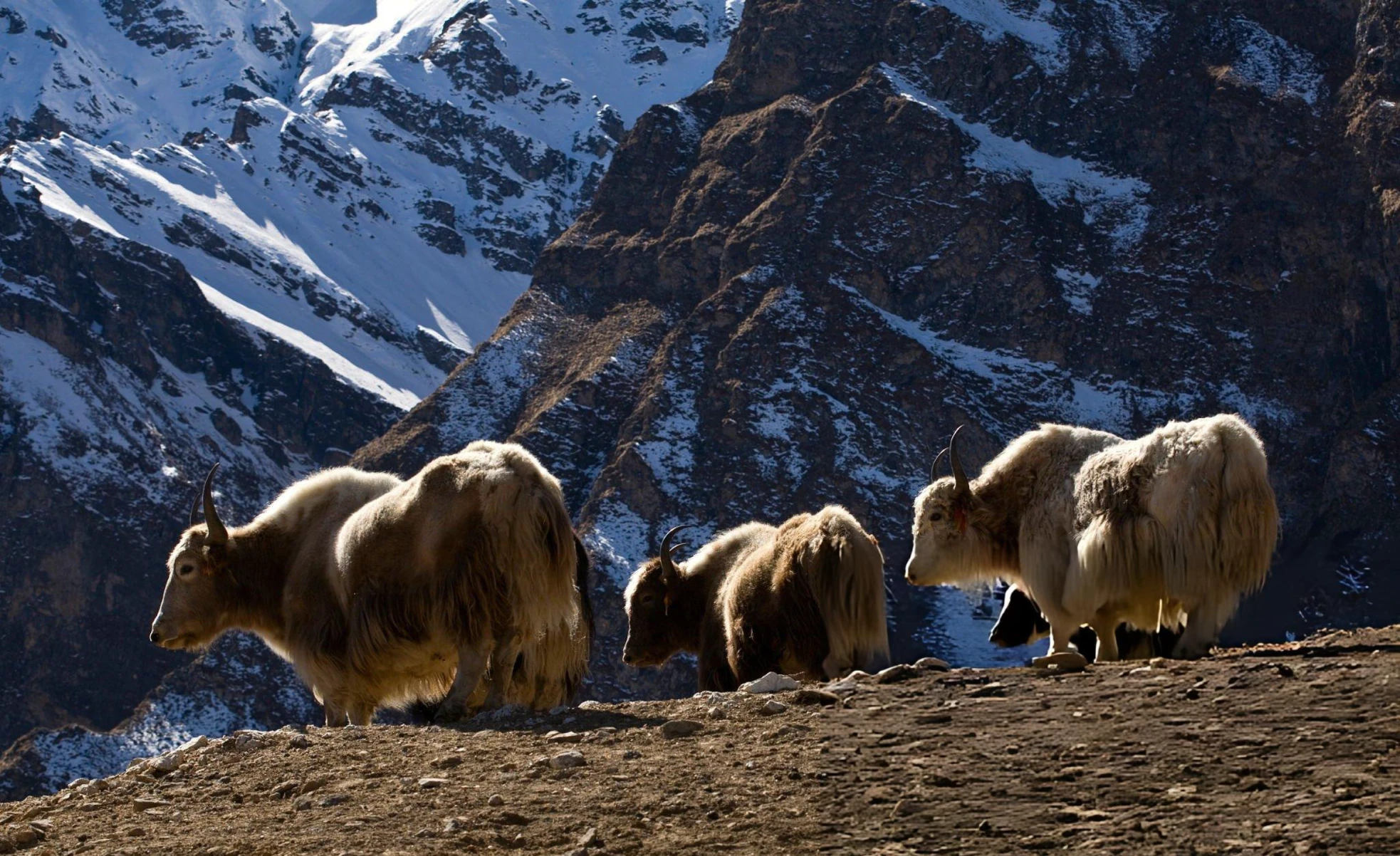
As you walk along the valleys, you will see herds of yaks and dzos (yaks and cows crossed with each other) grazing on high meadows. These animals are not livestock; they form the cornerstone of existence. They provide:
- Dairy and milk products (especially important yak butter tea)
- Wool is used to make clothes and is woven.
- Meat for protein
- Transport capabilities
- Even dung to burn in a deserted country.
Observing how herders handle these animals across impossibly steep terrain is an indication of a well-developed skill set over generations. This association between man and animal is utilitarian but, at the same time, very respectful; life is determined by knowledge of animal behavior and demands.
Food Culture in the High Himalayas
Nar and Phu cuisines reflect the harsh existence in the highlands. Food is not a question of culinary delight, but of energy, and survival--but the outcome is surprisingly gratifying.
The basis of everyday food is tsampa (roasted barley flour). Combined with hot tea or butter, it is made into a thick, high-energy dough that supports extended hours of herding and agricultural work. It is modest yet smart food for places where calories are gold.
Thukpa (warm noodle soup) is an excellent way to fight a biting cold. Filled with vegetables or yak meat, it is both pragmatic and heartening.
The cultural signature drink is Salty Yak Butter Tea-smoky, rich, and surprisingly good. The act of drinking this tea with natives is a sort of cultural communion; it is the flavor of the mountains themselves.
Another aspect of clever adaptation is observed in food preservation. Dried meat is also suspended from ceilings, and fermented vegetables are packed away for use during winter. These are not cute customs; they are survival technologies honed over centuries.
Folklore and Belief: The Unseen World.
Local guides and villagers you encounter along the way will tell you stories that often obscure the distinction between mythology and reality. These are not performances for tourists, but real beliefs that define how individuals perceive the world around them.
The communities strongly believe in Dharma protectors, fierce guardian spirits, who are supposed to ensure that the Buddhist faith and the community are not harmed. High mountains are held in great esteem as the holy abodes of mountain deities that should be honored by praying, offering, and ceremony. People take a moment to recognize these invisible forces that define life, before significant life events.
There are numerous myths of the various accounts of how the Nar Phu Valley itself was formed- creation myths which have been transmitted orally through generations and which infuse some spiritual meaning into the very terrain.
For adventure trekkers, these beliefs make the trekking experience unique. It is not merely a mountain-range you are ascending; you are traversing a terrain that is both consecrated and mapped with spirituality by generations of people. As soon as a local talks about a spirit of the mountain or a spirit of protection, they are not being superstitious; they are only describing their reality as they perceive it to be.
Modernization vs Tradition: A Delicate Balance
This is where Nar and Phu get really interesting to the modern-day traveler: the villages are in a frantic attempt to balance the need to maintain the ancient culture with access to modern comforts.
Some homes are being powered by solar panels. The villages are reached by mobile networks. Power is present, but in short supply. Trekkers have become self-reliant by earning income via homestays and guided adventures. The cash economy has come.
But something extraordinary is occurring: the society is embracing modernity on its own terms, not giving up the tradition. Young people have solar-powered phones, yet they continue to assist with herding the yaks. At nightfall, families are seated with butter lamps, as were their forebears, although electric lighting is at hand. The elderly keep turning the prayer wheels as others take their pictures with modern cameras.
This balance is being actively supported by a number of NGOs concerned with:
- Reconstructions of old monasteries.
- Encouragement of old-fashioned weaving.
- Language conservation efforts
- Cultural knowledge preservation educational programs.
For trekkers, this means you are looking at a community actively deciding aspects of modernity to adopt and which traditions to preserve. It is not a museum frozen in time; it is a living, evolving culture that makes conscious decisions.
What Trekkers Can Expect?
Taking Nar and Phu as an adventure trekker will be going outside the box of tourism. Yes, you will have unbelievable mountain views and exercise. But what is more important, you will experience a real culture- people living by values created by mountains, Buddhism, and the wisdom of centuries.
You will have tea with families whose fathers went down these same streets. You will see religious practices older than modern civilization. You will see, and maybe see the first time, what it is to live in a real community, when one man is the maker of another man.
Nar and Phu are not a performance art, as it is a welcome recognition that human beings can live in the most drastic environments and still be deeply spiritual and socially significant. That is the best thing you can carry back to the mountains in a world that is increasingly efficiency and consumption-driven.
To wrap up, the adventure of Nar and Phu isn't measured in altitude summited or miles trekked. It's measured in moments of connection, in understanding that sparked across language barriers, in realizing that culture is real, living, breathing culture still exists in our modern world.
Trek into these valleys with an open heart, and you'll return transformed. The mountains will challenge your body, but the people and their traditions will challenge and expand your entire perspective on what it means to be human.
Explore Nar and Phu Valley with Nepal Vision Treks.
Book your cultural Himalayan journey today.
FAQS