Nepal vision | 06/08/2026
A trip to Bhutan in 2027 costs at minimum US$100 per person per night in mandatory government fees, plus separate accommodation, guide, transport and meal costs that typically bring a standard trip to around US$250 to US$400 per person per day, or considerably more for luxury lodges. The best time to visit is March to May or September to November, both for weather and for Bhutan's major festivals, the Paro Tshechu (spring) and Thimphu Tshechu (autumn). Every visitor, regardless of budget, pays the same government fee and books through the same licensed-operator system; there is no genuine "budget" tier in Bhutan, only different levels of comfort layered on top of a fixed floor.
Bhutan works differently to almost anywhere else you might plan a trip to, and understanding that difference before you start pricing out an itinerary saves a lot of confusion later. This guide covers what actually shapes the cost of a 2027 trip, when to go depending on what you want from it, and what changes between a standard trip, a luxury one, and a trip built specifically around one of Bhutan's festivals, since these aren't really three different products so much as three different ways of spending on top of the same foundation.
Bhutan at a Glance
Factor | Detail |
| Sustainable Development Fee (SDF) | US$100 per person, per night (most nationalities), fixed through 31 August 2027 |
| SDF for children | Free under 6; 50% off (US$50/night) ages 6–11; full rate from age 12 |
| SDF for Indian nationals | INR 1,200 per night (roughly US$15) |
| Visa fee | US$40 one-time, non-refundable, processed with your e-visa |
| Booking method | Must be arranged through a licensed Bhutanese tour operator; independent SDF payment isn't possible |
| Only international airport | Paro (PBH), served by Druk Air and Bhutan Airlines |
| Typical total daily cost (standard tier) | US$250–US$400 per person per day, including SDF |
| Typical total daily cost (luxury tier) | US$700–US$2,000+ per person per day, including SDF |
| Best seasons | March–May (spring) and September–November (autumn) |
| Major festivals in 2027 | Punakha Tshechu (mid-February), Paro Tshechu (March/April), Thimphu Tshechu (September/October) |
Understanding Bhutan's Tourism Model
What the Sustainable Development Fee Actually Is
Nearly every question about Bhutan's cost starts here, so it's worth explaining properly. The SDF is a nightly government levy, currently US$100 per person for most visitors, that funds free healthcare and education for Bhutanese citizens, environmental conservation, and cultural preservation. It replaced Bhutan's older "Minimum Daily Tariff" system in 2022, which used to bundle the government's share directly into a fixed all-inclusive daily package rate. Since that change, the SDF is now billed separately from your actual trip costs, meaning your accommodation, meals, guide, and transport are quoted and paid for independently, on top of the SDF rather than folded invisibly inside it.
The rate itself has moved: it launched at US$200 per night in 2022, then was halved to US$100 per night in September 2023 specifically to encourage longer stays and rebuild visitor numbers after the pandemic. That reduced rate is confirmed through 31 August 2027, after which a rate review is expected, though nobody can say with certainty what happens next. If your 2027 travel dates fall before that deadline, you're paying the reduced rate; if you're weighing a trip for late 2027 with any flexibility, booking earlier rather than later is the safer move, purely from a cost perspective.
Why There's No Real "Budget" Tier in Bhutan
This is the single biggest difference between planning a Bhutan trip and planning almost anywhere else covered on this site. In Nepal, you can genuinely choose a shoestring teahouse trek or a luxury lodge experience on the same trail, and the price gap reflects real comfort differences layered on comparable base costs. In Bhutan, the SDF alone puts a hard floor under every trip regardless of how modestly you travel: a bare-minimum 7-night trip already costs at least US$700 in government fees before a single hotel room or meal is booked. There's no equivalent of a basic teahouse trek here. Every visitor travels with a licensed guide, arranged transport, and pre-booked accommodation, because independent, unguided tourism isn't how Bhutan's system is built to work.
What does vary, considerably, is what sits on top of that floor: whether you're staying in a comfortable 3-star hotel or a five-star mountain lodge, whether you're moving between valleys by shared road transport or private helicopter, whether your itinerary is a fixed group schedule or built entirely around your own interests. That's the real luxury-versus-standard distinction in Bhutan, and it's worth understanding clearly, because "budget Bhutan" content elsewhere online can be genuinely misleading about how low the floor actually goes.
What the SDF Covers, and What It Doesn't
The SDF funds government programmes; it does not cover your trip logistics. Accommodation, meals, your guide's fee, in-country transport, and entrance fees to individual dzongs and monasteries are all billed separately as part of your tour package. A useful mental model: the SDF is the cost of Bhutan allowing you in at all, calibrated deliberately to keep visitor numbers lower and per-visitor spending higher than mass tourism destinations. Everything else is the cost of the actual trip you build on top of that.
Best Time to Visit Bhutan in 2027
Spring (March to May): Rhododendron forests bloom across the hillsides, valley temperatures are mild, and visibility toward the high Himalayan peaks on the northern border is generally strong. This is also when the Paro Tshechu, Bhutan's most photographed festival, takes place.
Autumn (September to November): Widely considered the clearest, most stable weather window of the year, following the summer monsoon's dust-clearing effect, with crisp air and reliably good mountain visibility. The Thimphu Tshechu, held in the capital, falls in this window and draws Bhutan's largest festival crowds.
Winter (December to February): Cold, particularly at altitude, but generally dry and clear, with noticeably fewer visitors. The Punakha Tshechu, in the lower, warmer Punakha valley, falls in mid-February and is a genuine option for anyone wanting festival exposure without spring or autumn crowds.
Summer/monsoon (June to August): The wettest season, with regular rainfall and reduced visibility, generally the least recommended window for a first visit, though it's the quietest and occasionally the cheapest time to travel.
Bhutan's 2027 Festival Calendar
Bhutan's Tshechus follow the Bhutanese lunar calendar, not the Gregorian one, which means exact dates shift year to year and aren't fully finalised until roughly six to twelve months in advance by Bhutan's Central Monastic Body. With that caveat firmly in mind, the tentative 2027 windows currently circulating among Bhutan operators are:
- Punakha Tshechu: mid-February 2027, at Punakha Dzong
- Paro Tshechu: late March into April 2027 (exact five-day window still being finalised across sources), at Rinpung Dzong
- Thimphu Tshechu: September or October 2027, at Tashichho Dzong
Treat these as planning windows rather than locked dates. If a festival is the reason you're travelling, confirm the exact dates with a licensed operator six to nine months ahead rather than booking flights around a date pulled from any single source online, including this one.
Three Ways to Travel Bhutan in 2027
Standard Travel
A standard Bhutan trip books through the same licensed-operator system as every other visitor, staying in comfortable 3-star hotels (with the option to upgrade specific nights to 4 or 5-star at extra cost), travelling by shared or private road transport depending on group size, and following a fairly conventional western-loop itinerary: Paro, Thimphu, and Punakha, with Bumthang or Gangtey added for longer trips. This is the right starting point for most first-time visitors, delivering the full core Bhutan experience, the dzongs, the Tiger's Nest hike, the Punakha valley, without paying for helicopter transfers or five-star lodges you may not particularly need.
Luxury Travel
Luxury Bhutan travel doesn't buy a different itinerary so much as a different way of moving through the same one. The country's small handful of ultra-luxury lodge brands, Amankora, COMO Uma, and Six Senses among them, offer genuinely exceptional properties spread across the main valleys, often designed by internationally recognised architects and built to blend into the landscape rather than dominate it. Beyond accommodation, luxury tiers typically add a private guide and vehicle dedicated to your party alone rather than a shared group schedule, the option of helicopter transfers between valleys instead of the standard multi-hour road drives, and access to experiences a standard itinerary doesn't reach: private audiences with monastery custodians, bespoke dining, or flexible scheduling around festival crowds rather than a fixed group timetable.
It's worth being clear that luxury in Bhutan is an addition on top of the same fixed government floor, not a replacement for it. Every luxury traveller still pays the same US$100 nightly SDF as every standard traveller; the difference sits entirely in what's layered above it.
Festival Travel
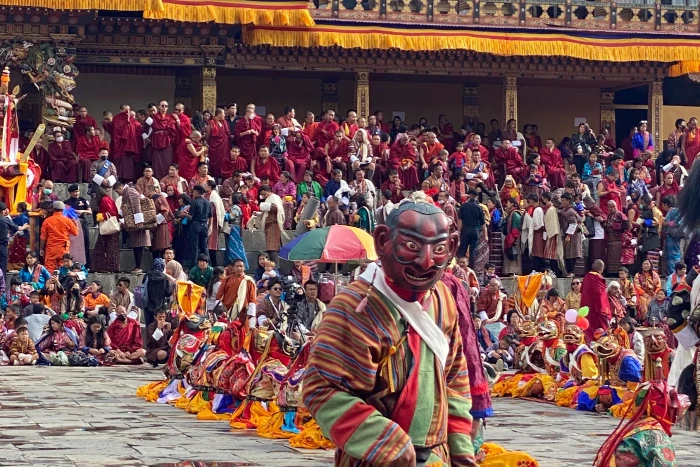
Timing a trip specifically around a Tshechu changes the planning calculus in ways worth understanding before you commit to dates. Because festival dates follow the lunar calendar and shift annually, and because the two biggest festivals draw the heaviest demand for hotel rooms and experienced guides of the entire year, festival travel needs the earliest booking window of the three styles covered here, commonly six to nine months ahead for Paro or Thimphu Tshechu specifically. Smaller, less internationally known festivals, the Punakha Tshechu, the Bumthang region's Jambay Lhakhang Drup, or district-level Tshechus, offer a genuine alternative for travellers who want the cultural experience with less competition for rooms and guides, often at standard rather than peak-season pricing.
A festival-timed itinerary typically builds several unstructured days around the festival dates themselves, since the Tshechu is usually a multi-day event you'll want to return to across more than one session, alongside the standard sightseeing circuit either side of it.
Realistic Cost Breakdown for 2027
Using the SDF as the fixed baseline, here's roughly how total daily cost stacks up by travel style for 2027, before international flights:
- SDF (all styles): US$100 per person, per night
- Standard tier package cost: typically an additional US$150 to US$250 per person, per day, covering 3-star accommodation, meals, guide, and transport, bringing the total to roughly US$250 to US$350 per person, per day
- Luxury tier package cost: an additional US$600 to US$1,900+ per person, per day depending on the specific lodge brand and whether helicopter transfers are included, bringing the total to roughly US$700 to US$2,000+ per person, per day
- Visa fee (one-time, all styles): US$40
- Flight to Bhutan from Nepal: Roughly around US$500
As of 2026, Bhutan also applies a 5% GST to tour services (not to the SDF itself), which adds a modest amount to package pricing compared to the previous sales tax structure, worth factoring into any quote you receive for 2027 travel.
For a 7-night standard trip, that puts a realistic total somewhere around US$1,750 to US$2,450 per person before flights; for the same length luxury trip, expect US$4,900 to US$14,000 or more per person, depending heavily on which specific lodges and how much helicopter transport are included.
Sample Itinerary for Bhutan (combined with Nepal)
Since Bhutan's only international airport connects through a limited number of hubs, and Kathmandu is one of the best-served and most convenient of those, we build a few days in Nepal into most of our Bhutan itineraries as standard, not as padding, but because it turns a single-country trip into two genuinely complementary destinations without adding much to your total travel time. Here's how that looks across all three travel styles.
Standard: 10 Days (2 Nights Kathmandu + 7 Nights Bhutan + 1 Night Kathmandu)
Day 1: Arrive Kathmandu. Transfer to your hotel, evening at leisure to recover from international travel.
Day 2: Kathmandu sightseeing. A guided day taking in Swayambhunath, Pashupatinath, and Boudhanath, three of the valley's UNESCO World Heritage Sites, while our team finalises your Bhutan visa and SDF paperwork in the background.
Day 3: Fly Kathmandu to Paro. One of the most scenic scheduled flights in the world on a clear day, tracing the Himalayan range with Everest, Kanchenjunga, and eventually the peaks around Bhutan itself visible from the window. Afternoon at leisure in Paro, with an optional short walk to Ta Dzong, the national museum.
Day 4: Paro, hike to Tiger's Nest. A full day dedicated to Paro Taktsang, Bhutan's most iconic monastery, perched on a cliff face 900m above the valley floor. The hike up and back takes 4 to 5 hours at a comfortable pace.
Day 5: Drive Paro to Thimphu. A short 1.5-hour drive to the capital, with an afternoon of sightseeing including the giant Buddha Dordenma statue and Tashichho Dzong.
Day 6: Thimphu full day. The Folk Heritage Museum, the National Memorial Chorten, and time in the capital's markets and craft shops.
Day 7: Drive Thimphu to Punakha via Dochula Pass. A stop at Dochula's 108 memorial chortens, weather permitting, with views toward the Bhutanese Himalaya, before descending into the warmer Punakha valley to visit Punakha Dzong, set at the confluence of two rivers.
Day 8: Punakha valley. A walk across Bhutan's longest suspension bridge and a visit to Chimi Lhakhang, the temple dedicated to the "Divine Madman," before driving back to Paro.
Day 9: Fly Paro to Kathmandu. Evening farewell dinner in Kathmandu.
Day 10: Departure from Kathmandu.
Luxury: 10 Days (2 Nights Kathmandu + 7 Nights Bhutan + 1 Night Kathmandu)
The same core route, at a different pace and in a different tier of property throughout.
Days 1–2: Kathmandu, staying in a five-star property, with the option to add a Chandragiri Cable Car morning for an easy first taste of Himalayan views before you've even reached Bhutan.
Days 3–9: Paro, Thimphu, and Punakha, following the same route as the standard itinerary but staying at Amankora's or COMO Uma's lodges in each valley, with a private guide and vehicle dedicated to your party throughout rather than a shared schedule. Where the standard itinerary drives between valleys, this version offers the option of a helicopter transfer instead, particularly useful for extending the trip into Bumthang or the Gangtey valley without adding full driving days on either end. Dining, pacing, and free time are built around your preferences rather than a fixed group timetable.
Day 10: Fly Paro to Kathmandu, departure.
Festival: 12 Days (2 Nights Kathmandu + 9 Nights Bhutan + 1 Night Kathmandu)
Built specifically around either the Paro or Thimphu Tshechu, with extra nights in Bhutan to allow multiple sessions at the festival itself.
Days 1–2: Kathmandu, arrival and sightseeing as above.
Day 3: Fly to Paro. Timed to arrive two to three days before the festival begins.
Days 4–5: Thimphu sightseeing and acclimatisation, arriving at the festival grounds already settled rather than jet-lagged.
Days 6–8: The Tshechu itself, returning to the festival across its multi-day run, since a single visit rarely does justice to a Tshechu's full sequence of masked dances, and the atmosphere shifts noticeably from day to day.
Days 9–10: Punakha, added either before or after the festival depending on which Tshechu you're targeting and how the dates fall that year.
Day 11: Fly Paro to Kathmandu, farewell dinner.
Day 12: Departure from Kathmandu.
Visa, Entry and Booking Lead Time for 2027
Bhutan's tourist visa is only obtainable through a licensed Bhutanese tour operator; there's no independent visa or SDF payment route for leisure travellers. Your operator submits your visa application alongside your SDF payment through the official Tourism Council of Bhutan portal, typically well in advance of your trip.
Paro is Bhutan's only international airport, served by a limited number of flights daily on Druk Air and Bhutan Airlines, mainly connecting through Kathmandu, Delhi, Kolkata, Bangkok, Singapore, and a handful of other regional hubs. Seat availability on these routes is genuinely limited compared to more heavily served destinations, and it tightens further around the two major festival windows. For standard travel, booking three to four months ahead is generally sufficient; for luxury lodges with limited room inventory, or for either major festival, six to nine months ahead is the safer window, and travellers with any date flexibility around Paro or Thimphu Tshechu specifically should treat that lead time as a minimum rather than a comfortable buffer.
What we want you to understand before you go
Bhutan doesn't really offer three different trips so much as one trip with three different ways of experiencing it. The government fee is the same for everyone, the guide-and-operator system is the same for everyone, and the country you'll actually see, the dzongs, the festivals, the Himalayan foothills, doesn't change based on what you're spending above that floor. What changes is comfort, flexibility, and access: a standard trip gives you the full, real Bhutan experience without unnecessary extras; a luxury trip removes friction and adds a small number of genuinely exceptional properties and experiences; a festival-timed trip trades some booking flexibility for a specific, deeply memorable cultural window that doesn't repeat on the same dates twice.
If you're planning a 2027 trip and haven't decided which style fits, the honest answer is that most first-time visitors are well served by a standard itinerary with a festival built in if the dates align, saving the luxury lodge experience for a return trip once you know exactly which valleys and which parts of Bhutan you'd want to slow down in. Whichever you choose, book earlier than you think you need to, particularly if a festival date or a specific luxury property is central to the plan, since Bhutan's deliberately limited capacity means the popular windows fill up well before the rest of the calendar even starts to.
Planning a trip to Bhutan for 2027? Get in touch with Nepal Vision Treks at our office on Dabali Marg, Thamel, Kathmandu, call or WhatsApp us on +977 9802342081, or email [email protected], and we'll help you work out whether a standard, luxury, or festival-timed itinerary fits what you're actually after, and lock in the current SDF rate before it's reviewed.

Frequently Asked Questions