Nepal vision | 10/08/2026
The Kanchenjunga Base Camp Trek should be planned for March to May or September to early December 2027, not the deep winter window that works for some other remote Nepal treks, since the Selele La pass complex connecting the North and South Base Camp routes becomes genuinely hazardous once heavy snow sets in. Budget roughly US$90 in permits alone, on top of a full-board guided package, and book six to eight months ahead given limited Bhadrapur flight frequency and genuinely scarce teahouse capacity above Ghunsa.
If you've already looked at our full Kanchenjunga Base Camp Trek itinerary, you'll know this is one of the more serious undertakings in our catalogue: 23 days, both the North and South Base Camps on a single trip, and a level of remoteness that most trekkers in Nepal never actually experience. This guide fills in everything that itinerary page doesn't cover in depth, the seasonal logic, the real cost breakdown, the permit rules as they stand for 2027, and how this trek stacks up against the other remote options you might be weighing it against.
Why January to March Doesn't Work for Kanchenjunga
If you've read our other 2027 planning content, you'll know we generally point people toward the standard March-to-May and September-to-November windows for most treks, and toward Manang specifically for the January-to-March winter tracking season if snow leopards are the goal. Kanchenjunga breaks from that pattern in an important way, and it's worth understanding why before you set your dates.
The trek's defining technical challenge, the Selele La pass complex connecting Ghunsa on the northern route to Cheram on the southern side, isn't a single defined saddle but a sequence of high passes crossed over one long, exposed day with minimal shelter. In deep winter, heavy snowfall can render this crossing genuinely dangerous or outright impassable, and unlike Everest Base Camp or the Annapurna Circuit, where a well-trodden winter trail and established rescue infrastructure exist even in the coldest months, Kanchenjunga's crossing sees so little winter traffic that snow clearance and trail-breaking simply aren't things you can rely on. Where Manang's snow leopard season specifically wants winter snow cover to push prey down into searchable terrain, Kanchenjunga's Selele La wants the opposite: a clear, stable weather window without the deep snow load that makes the pass genuinely risky to cross.
Spring (March to May) is generally the stronger of the two windows for this specific trek, since the pass has typically cleared enough from winter snowfall to be safely crossable, rhododendron forests bloom through the lower valleys, and the extended daylight hours give more margin on the long Selele La crossing day itself.
Autumn (September to early December) offers the clearest mountain visibility of the year, following the monsoon's dust-clearing effect, though trekkers heading out later in this window, into late November or December, should expect colder conditions and a shorter margin before winter snow begins accumulating on the pass again.
Monsoon (June to August) is not viable for this route at all, for the same reasons it's discouraged everywhere in Nepal: landslide risk, obscured visibility, and genuinely unpleasant trekking conditions on a route that already has limited infrastructure to fall back on.
Kanchenjunga Trek Cost 2027: Permits, Package and Flights, Broken Down
Total cost for this trek breaks down into several genuinely distinct pieces, and it's worth understanding each rather than looking at a single bottom-line figure.
Permits: The Kanchenjunga Restricted Area Permit (RAP) costs US$20 per person per week for the first four weeks, and this 23-day itinerary falls within that window, bringing the RAP to roughly US$80 for the trip. The Kanchenjunga Conservation Area Permit (KCAP) is a flat NPR 2,000, roughly US$15, regardless of trek length. Combined, expect to pay around US$90 to US$95 per person in permits alone, genuinely modest compared to some of Nepal's other restricted regions, and this is included in our full package price rather than billed separately.
Domestic flights: Kathmandu to Bhadrapur and the return leg typically runs to roughly US$140 per person each way on standard fixed-wing service, meaningfully different from the mountain flights most trekkers associate with Nepal, since this route crosses the flat southeastern Terai rather than approaching a high-altitude airstrip.
Ground transport: The road transfer from Bhadrapur to Taplejung, and the further leg to Sekhathum where the trekking begins, is typically arranged as private vehicle transport within a full-service package, though shared jeep options exist independently at a considerably lower cost for travellers arranging logistics themselves rather than booking an all-inclusive trip.
Guide and porter fees: Independent daily rates for a licensed guide in this region typically run US$30 to US$35 per day, with porters around US$25 per day, though within a full Nepal Vision Treks package these are bundled into the overall price alongside accommodation and meals rather than charged separately.
What we'd recommend: given the genuine complexity of coordinating restricted-area permits, Bhadrapur flights, multi-day road transfers, and guide logistics for a 23-day trip into one of Nepal's least-serviced regions, this is not a trek where piecing together your own independent logistics saves meaningful money once you account for the time and risk involved in getting each piece wrong. Get in touch with us directly for a current, exact 2027 package quote, since a trip this remote genuinely benefits from a fixed, all-inclusive price rather than a collection of independently priced pieces that can go wrong in isolation.
How Far Ahead to Book: Bhadrapur Flights and Limited Teahouse Capacity
This is where Kanchenjunga diverges most sharply from planning advice for Nepal's more popular treks. Bhadrapur flights operate on considerably lower frequency than Lukla or Pokhara routes, and seat availability during the September-to-November peak window tightens meaningfully given the smaller number of daily departures serving the route. Combined with teahouse capacity above Ghunsa that's genuinely limited, some of the smaller lodges on this route can accommodate only a handful of groups at a time, booking a Kanchenjunga trip late is a considerably bigger risk than booking a late Everest Base Camp or Annapurna trip, where infrastructure has scaled to match demand over decades.
For 2027 departures, we'd recommend booking six to eight months ahead for either seasonal window, and earlier still if your dates fall within the narrower and more popular autumn stretch. This lead time also gives you room to properly prepare physically for a trek genuinely more demanding than most of Nepal's classic routes, which matters more here than almost anywhere else in our catalogue.
Kanchenjunga Restricted Area Permits 2027: RAP, KCAP and the Solo-Trekker Rule
Two permits are required for this trek, both processed exclusively through a registered Nepali trekking agency; neither is available independently regardless of experience level. The Restricted Area Permit costs US$20 per person per week for the first four weeks, rising to roughly US$25 per week beyond that, while the Kanchenjunga Conservation Area Permit is a flat NPR 2,000 with no time limit.
A meaningful regulatory change took effect in March 2026: Nepal's Department of Immigration removed the long-standing minimum group size requirement for restricted-area permits across all restricted districts, Kanchenjunga included. Previously, solo trekkers needed to either find a second trekker or pay a supplement to meet the minimum group requirement. That's no longer the case. A single trekker can now obtain the RAP independently, provided they still travel with a registered agency and a licensed guide, since the guide requirement itself hasn't changed and remains mandatory throughout the restricted zone, with a government-set ratio of one guide to a maximum of seven trekkers.
TIMS cards aren't required for this trek at all; the RAP replaces that requirement entirely. Checkpoints at Chiruwa, Lelep, and Ghunsa verify both permits against your passport at multiple points along the route, so carrying printed copies throughout the trek, not just digital scans, is worth building into your packing list.
North Base Camp vs South Base Camp: Why Our Itinerary Does Both
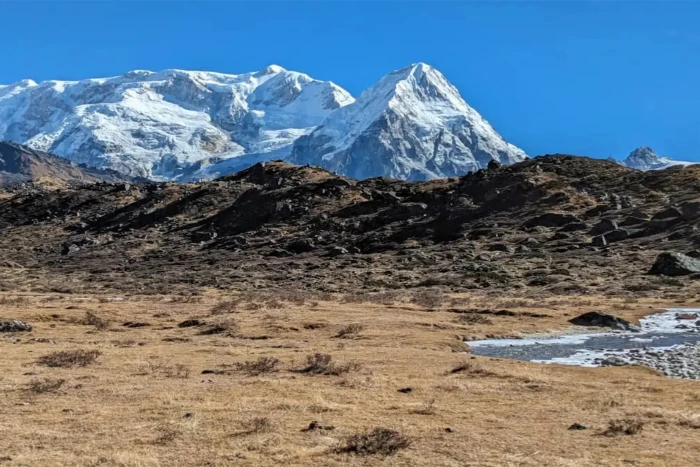
Most Kanchenjunga trekking packages choose one side of the mountain and stop there, and it's worth understanding why before comparing quotes between operators. The North Base Camp, near Pangpema at roughly 5,140m, is reached via Ghunsa, Kambachen, and Lhonak, and delivers a direct view onto Kanchenjunga's north face and the glacier system feeding it. The South Base Camp side doesn't offer quite the same walk-in to the base camp itself; instead, the Oktang viewpoint at roughly 4,740m, reached via Cheram and Ramche, delivers the definitive South Face panorama alongside Jannu (Kumbhakarna), widely considered one of the most dramatic peaks in the entire massif.
Connecting the two requires crossing the Selele La complex, which is precisely why most operators treat this as two separate, shorter treks rather than one combined circuit. Our itinerary crosses that pass deliberately, turning the trip into a genuine circuit that reaches both sides of the mountain on a single trip, which is the main reason this itinerary runs 23 days rather than the 18 to 20 days more typical of single-sided Kanchenjunga packages. If your priority is simply reaching one base camp in the shortest possible time, a single-sided itinerary is a legitimate, less demanding alternative worth asking us about. If you want the complete picture of Kanchenjunga from both directions, this combined route is, as far as we're aware, one of relatively few packages built specifically around doing both.
Is Kanchenjunga Right for You? Fitness and Prior Experience Checklist
We're direct about this on the itinerary page itself, and it's worth repeating here for anyone still deciding whether to commit to 2027 dates: this is not a recommended first major Himalayan trek. A few honest markers of whether you're ready for it:
You've already completed at least one trek reaching above 5,000m, ideally Everest Base Camp, the Annapurna Circuit, or the Manaslu Circuit, and know from direct experience how your body handles sustained altitude exposure over multiple consecutive days rather than a single high point followed by immediate descent. You're comfortable with genuinely basic teahouse conditions; above Ghunsa, facilities narrow considerably compared to the well-developed Khumbu or Annapurna corridors, and this isn't a trip for anyone expecting reliable hot showers or varied menus at altitude. You can commit to 23 days, most of them without mobile signal or easy resupply, in a region where rescue infrastructure is meaningfully thinner than Nepal's more popular trekking corridors. And you're prepared for one genuinely hard day, the Selele La crossing, that demands both physical stamina and a level head if weather or conditions shift unexpectedly.
If all of that sounds like a reasonable description of where you're at, Kanchenjunga is a genuinely extraordinary trek. If any of it gives you pause, we'd rather point you toward Manaslu or a single-sided Kanchenjunga itinerary first and have this trip waiting for you once you've built more altitude experience.

Kanchenjunga vs Manaslu vs Everest: Choosing the Right Remote Trek for 2027
If you're weighing Kanchenjunga against Nepal's other major remote or restricted-area options for 2027, a few honest distinctions are worth knowing. Everest Base Camp remains the most accessible of the three by a wide margin, with the most developed infrastructure, the most frequent flights, and the gentlest difficulty grading, a sensible choice if this is your first major Himalayan trek. Manaslu sits a step up in remoteness and difficulty, restricted-area status, mandatory guide, genuinely basic teahouses above Samagaon, but remains considerably more accessible than Kanchenjunga in terms of both flight logistics and overall trek length, typically wrapping up in 17 days rather than 23.
Kanchenjunga is the most demanding and most remote of the three by essentially every measure: the longest itinerary, the least developed infrastructure, the most limited flight access, and, on our combined North-South itinerary specifically, the added technical demand of the Selele La crossing. It's the right choice for trekkers who've already done Everest Base Camp or Manaslu and are specifically looking for the next serious step up, not for trekkers looking for their first restricted-area experience.
What to Pack for 23 Days in Nepal's Least-Visited Restricted Region
A few packing considerations specific to this trek, beyond the standard high-altitude kit list we provide at booking. Bring more layers than you think you need for the sections above Ghunsa specifically, since teahouse heating narrows considerably compared to better-resourced regions, and you'll be relying more heavily on your own gear for warmth in the evenings. A physical, printed copy of both permits, alongside your passport, matters more here than on routes with less rigorous checkpoint scrutiny, given the multiple verification points at Chiruwa, Lelep, and Ghunsa. Given the genuinely limited resupply options above Taplejung, bring any specific personal medications, snacks, or gear items in full for the entire trip rather than assuming you'll be able to purchase replacements along the way, an assumption that generally holds on the Everest or Annapurna routes but doesn't hold reliably here.
Ready to plan your 2027 Kanchenjunga Base Camp Trek? Get in touch with Nepal Vision Treks at our office on Dabali Marg, Thamel, Kathmandu, call or WhatsApp us on +977 9802342081, or email [email protected], and we'll confirm current permit costs, Bhadrapur flight availability, and a full package quote for your dates.
Frequently Asked Questions