Nepal vision | 14/05/2025
(This is a guest post written by Maisie Mcenzie, who did the ABC Trek with us in October 2024. Thank you so much, Maisie, for writing this beautiful article and recommending us.)
Back in 2024, after thoroughly researching the Annapurna Base Camp (ABC) trek and finally locking in the details, I found myself standing at the starting point of one of Nepal's most iconic trails.
Like many others, ABC had long been on my bucket list. It was not just for the promise of snow-capped peaks and rhododendron forests but also the challenge and sense of perspective such a trek can bring.
Despite my research and my imagination of what my day would look like, I was wrong, as the walk in the lap of the Himalayas alongside the natural and cultural gems of Annapurna was magical.
But today I am here to share more of the things I really wish I’d known before starting the trek, the kind of details that rarely show up in glossy travel write-ups but can make or break your experience out on the trail.
Annapurna Base Camp Trek Overview at a Glance
Annapurna Base Camp is located in the heart of the Annapurna region, passing by appealing views of the Annapurna and Machhapuchhre ranges. It will satisfy your heartfelt curiosity about the flapping chorten, spinning prayer wheel, and scattered small monasteries.
My journey begins in early October, as it is considered to be the best time to explore the alluring beauty of the trek. Alongside the great weather, comfortable temperature, and cultural highlights of the region, my 10-day journey includes nearly 61 miles of trail, 20,000 feet of elevation gain, and close to 30,000 relentless stone stairs. The Annapurna Base Camp trek is anything but a walk in the park.
The initial days started in the valley of Pokhara, where I immersed myself in the alluring beauty of the surrounding Machhapuchhre. Now begins your official trek as you gain elevation with the first clear look of the majestic Annapurna South and the Himchuli range.
In the upcoming days, you mark your way to the Deurali and then MBC (Machapuchare Base Camp). As you climb, Annapurna I and Annapurna South tower over you.
I was fortunate to encounter rare endangered species in the Annapurna Conservation Area, such as the elusive Himalayan tahr and the snow leopard.
The finale comes when you reach the Base Camp, surrounded by the Annapurna II, III, IV, Annapurna South, Gangapurna, Hiunchuli, and Machhapuchhre, and feel the sense of accomplishment of those physical challenges encountered throughout the trek.
But I did something different. I decided to skip the Poon Hill excursion, which is often added to the ABC trek, especially for sunrise views. While I was disappointed to miss the chance to see the iconic sunrise over the mountains, my body was starting to feel the strain from the stairs, and I needed to pace myself.
The Poon Hill detour would have added about 1.5 miles (2.4 km) and an additional 1200 feet (365 meters) of elevation to Day 3.
Given my exhaustion after Day 2’s intense climb, I chose to rest and adjust my pace. Still, if you’re feeling good, it’s a fantastic addition for some unforgettable sunrise views of Dhaulagiri, Machapuchare, and the surrounding peaks.
The Stairs Are No Joke
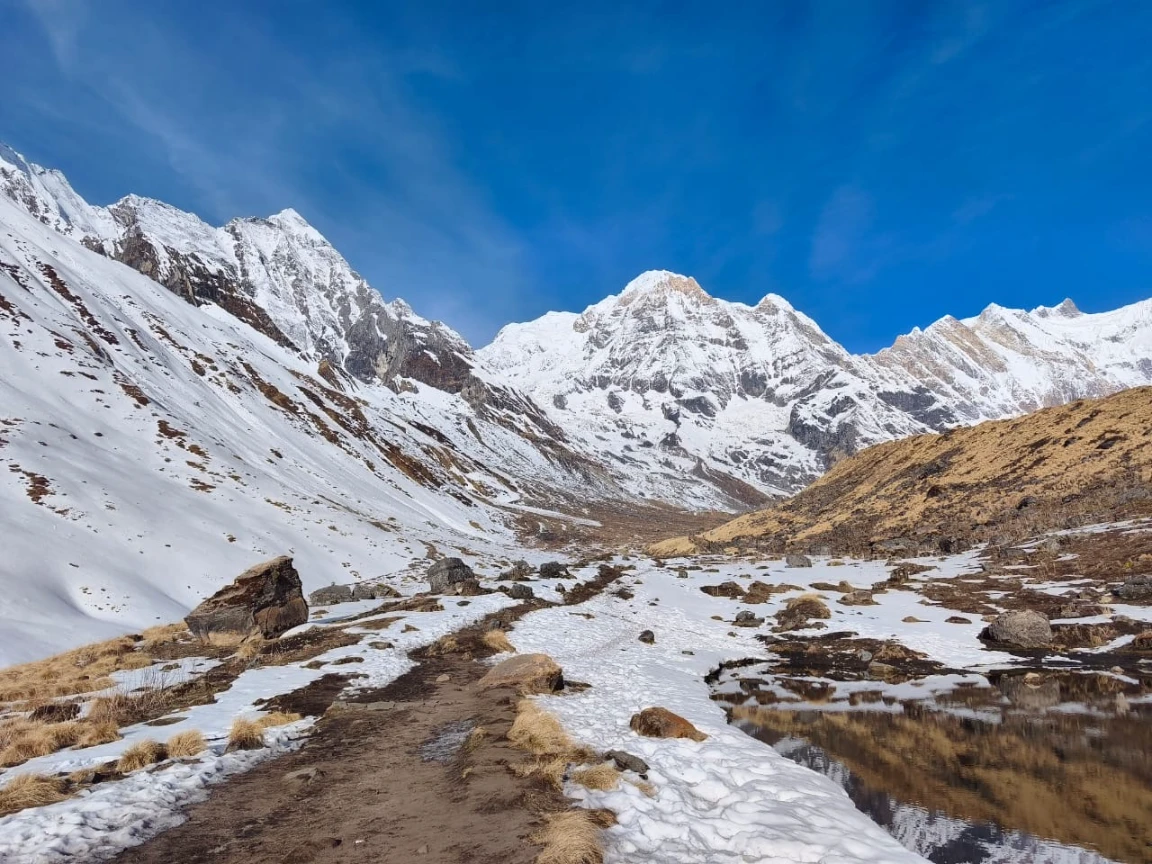
One of the biggest physical challenges of the Annapurna Base Camp trek is the crazy number of stairs. Every single day, I climbed thousands of stone steps, uphill, downhill, and everything in between. At times, it felt like I was stuck on an endless staircase winding through the mountains.
I read several resources and blogs beforehand, but very few mentioned the stairs or gave them the attention they truly deserve.
Believe me, they’re one of the most complex parts of the whole trek. Your legs will burn, and your knees will definitely feel it. By Day 3, I was already reaching for ibuprofen just to keep going. So if you have knee problems or joint issues, this is something you really need to think about in advance.
The constant stepping up and down is way more demanding than walking on flat ground or gentle trails. But if you go in mentally prepared and pace yourself, it’s totally doable.
Physical Fitness Training
My journey would have been even more challenging without my guide, Santosh Wagle, who encouraged me to start training a month before the trek began.
For my physical preparation, I started by simply walking more and taking the stairs whenever I could. I also consulted with my trainer, who helped me create a routine that combined cardio, strength training, and flexibility workouts. For that month, I could really feel the difference in my stamina and strength.
I also joined a local rock climbing arcade, which was a fun way to build both physical and mental endurance. At the gym, I used the stair-climbing machine, which was especially helpful; it felt just like the long uphill stretches of the trek. Thanks to all of this, I was able to handle the physical challenges much better than I expected.
Mental Strength Matters More Than Physical Fitness
Before I started the Annapurna Base Camp trek, I had to be really athletic to make it through. But after doing it, I realized something surprising: being mentally strong was more important than being in top physical shape.
Don’t get me wrong, being active helps. But what really got me through the hardest days wasn’t big muscles or a running habit. It was stubbornness. I just kept telling myself, “One step at a time. Keep going.” That mindset helped me more than anything else.
There were moments when I was sore, tired, and out of breath, but instead of pushing too hard, I learned to pace myself. Taking it slow, resting when needed, and staying positive helped me build endurance as the days went on. You don’t need to rush or prove anything. The goal is to finish strong, not fast.
So if you’re someone who hasn’t trained like an athlete but really wants to do this trek, you absolutely can. As long as you're healthy, prepared, and mentally committed, your determination can carry you far, even through thousands of stairs and long days of walking.
How I Prepared Physically
My journey would have been even more challenging without my guide, Santosh Wagle, who encouraged me to start training a month before the trek began. For my physical preparation, I started by simply walking more and taking the stairs whenever I could. I also consulted with my trainer, who helped me create a routine that combined cardio, strength training, and flexibility workouts. For that month, I could really feel the difference in my stamina and strength. I also joined a local rock climbing arcade, which was a fun way to build both physical and mental endurance. At the gym, I used the stair-climbing machine, which was especially helpful; it felt just like the long uphill stretches of the trek. Thanks to all of this, I was able to handle the physical challenges much better than I expected.
What the Trek Actually Looks Like: A Day-by-Day Overview
One thing I genuinely wish I had found before I left was a clear, honest breakdown of what each day involves. Here is a rough outline of how the classic 10-day ABC trek unfolds, based on my own experience going via Ghorepani and Poon Hill.
Day 1: Fly Kathmandu to Pokhara, drive to Tikhedhunga After an early morning flight into Pokhara, we drove to Tikhedhunga. It is a short but scenic introduction to what lies ahead. The village sits at around 1,540 metres and serves as the true beginning of the trek.
Day 2: Tikhedhunga to Ghorepani This is the day the stairs begin in earnest. The climb up to Ulleri is relentless, over 3,000 stone steps in a single go. I will not sugarcoat it: this was one of the hardest mornings I have had on any trek. Ghorepani sits at 2,860 metres, and the teahouses there were very welcome.
Day 3: Poon Hill sunrise, then trek to Tadapani We rose at 4:30 am to climb Poon Hill (3,210 metres) for sunrise. Even through tired legs, the panoramic view of Dhaulagiri, the Annapurna range, and Machhapuchhre glowing in early morning light made every single step worth it. We then descended and trekked on to Tadapani.
Day 4: Tadapani to Chhomrong Chhomrong is known as the gateway to the Annapurna Sanctuary and sits at 2,170 metres. The trail passes through rhododendron and oak forests and offers the first dramatic close-up views of Annapurna South. There is a permit checkpoint here; have your TIMS card ready.
Day 5: Chhomrong to Dovan The trail descends sharply from Chhomrong before climbing back up through dense bamboo and rhododendron forest. You pass through Sinuwa and Bamboo before reaching Dovan at 2,600 metres. This is where the forest starts to feel genuinely remote.
Day 6: Dovan to Machhapuchhre Base Camp (MBC) The landscape changes dramatically. The forest gives way to open alpine terrain, and the trail follows the Modi Khola river. Machhapuchhre Base Camp sits at 3,700 metres, and the views of the Fishtail peak above you are extraordinary.
Day 7: MBC to Annapurna Base Camp and back to MBC This is the day everything you have worked for comes together. The final climb to ABC at 4,130 metres takes roughly two to three hours from MBC. Standing at the base camp, completely encircled by Annapurna I, Annapurna South, Gangapurna, Hiunchuli, and Machhapuchhre, I genuinely could not speak for a few minutes. It is overwhelming. We returned to MBC for the night.
Day 8: MBC to Bamboo The descent begins. Your knees will know about it.
Day 9: Bamboo to Jhinu Danda Jhinu Danda has natural hot springs by the river, and after eight days of trekking, soaking your legs in them was one of the greatest feelings of my life. Do not skip this.
Day 10: Jhinu Danda to Pokhara A final morning of walking brings you to Nayapul, from where jeeps run back to Pokhara. By evening, you will be sitting in a lakeside restaurant in Pokhara, likely ordering something that is not dal bhat, and feeling extremely pleased with yourself.
What to Pack: The Honest List
I overpacked. Almost everyone does on their first Himalayan trek. Here is what actually mattered:
Footwear: Broken-in, waterproof trekking boots with good ankle support are non-negotiable. Do not attempt this in trail runners unless you have done serious mileage in them. Pack a pair of light sandals or flip-flops for evenings at the teahouse.
Layers: The temperature swings dramatically between valley floors and higher elevations. I wore a moisture-wicking base layer, a fleece mid-layer, and a waterproof hardshell every single day. At ABC, temperatures can drop below freezing at night even in October.
Trekking poles: I was sceptical before going. By Day 2, I was utterly dependent on them. They save your knees on the descents more than anything else.
Sleeping bag: Teahouses provide blankets, but at higher elevations, these are not warm enough on their own. A sleeping bag rated to at least -10°C is worth carrying or renting in Pokhara.
Backpack: A 35 to 45-litre pack is ideal for your daypack if you have a porter. If you are carrying everything yourself, go up to 60 litres, but seriously consider hiring a porter instead.
Other essentials: Headtorch with spare batteries, sunscreen (SPF 50 minimum , the UV at altitude is intense), lip balm, blister plasters, ibuprofen, rehydration sachets, a water bottle or hydration bladder plus purification tablets, and a small first aid kit.
What to leave behind: Hair dryers, heavy books, multiple pairs of jeans, and anything you are not prepared to carry yourself up 30,000 stairs.
What was my teahouse experience in Annapurna?
You will stay in teahouses for the entire trek, and they are genuinely one of the things I loved most about the experience. At lower elevations, particularly around Ghorepani and Chhomrong, they are surprisingly comfortable: private rooms with proper beds, hot showers, charging points, and even Wi-Fi in some places. As you gain altitude, facilities simplify. By the time you reach Machhapuchhre Base Camp, you are looking at shared bathrooms, cold water only, and thin walls that do very little to keep out the cold.
The food, though, is consistently excellent throughout. Dal bhat with unlimited refills is the trekker's staple and genuinely the best thing you can eat on the trail. The carbohydrates sustain you, and the warmth is welcome. You will also find momos, thukpa, pasta, fried rice, pancakes, and plenty of hot tea and coffee at almost every stop.
One thing worth knowing: at higher elevations, prices increase noticeably. A bottle of water that costs NPR 50 in Pokhara might cost NPR 250 at Annapurna Base Camp. This is entirely reasonable given how difficult it is to supply these places, but budget for it accordingly.
When is The Best Time for the ABC Trek?
Going in early October, as I did, is genuinely ideal. Autumn (late September to November) is the most popular season for very good reasons. The monsoon has cleared the air, the skies are sharp and blue, and the mountain views are at their finest. Temperatures are comfortable during the day and cold but manageable at night.
Spring (March to May), in my humble personal opinion, is the second-best window. Rhododendrons bloom spectacularly along the lower trails, and visibility is generally good, though it can cloud over in the afternoons more frequently than in autumn. I did trek around the region back in 2016, but I still prefer the Autumn season. Yes, I know people can differ with me on this one.
Monsoon season (June to August) brings heavy rain, slippery trails, leeches on the lower paths, and the very real risk of landslides. It is possible, but I would not recommend it for a first visit. The trail is already difficult as it is, so you do not want to take on more challenges unless that's your thing.
Winter (December to February) sees snowfall at higher elevations and can be bitterly cold, but the trails are quiet and the views on clear days are extraordinary. Some teahouses close in the deepest winter months, so check ahead. I've seen recent trends of people going for it in December or February, so people can find the peace in the trail and enjoy the snow and mountain without rush as well.
Altitude Sickness: Take It Seriously
ABC sits at 4,130 metres, which is high enough for altitude sickness (Acute Mountain Sickness, or AMS) to become a genuine concern. I felt the beginnings of a headache on the approach to Machhapuchhre Base Camp and was grateful that Santosh had talked me through the warning signs beforehand.
The golden rules are simple: ascend slowly, drink three to four litres of water per day, avoid alcohol, eat well, and listen to your body. If you develop a persistent headache, nausea, dizziness, or feel unusually breathless at rest, do not push on. Descend immediately, even if it means losing a day's progress. No view is worth a serious medical emergency.
Some trekkers use Diamox (acetazolamide) as a preventative measure. I did not, but it is worth discussing with a doctor before you leave home if you are concerned. Do not take it for the first time on the mountain without knowing how your body reacts.
Do You Need a Guide? (And What the Rules Say Now)
This question came up constantly among trekkers I met on the trail. The honest answer is that as of recent regulations introduced by the Nepal government, solo independent trekking in the Annapurna region is no longer permitted. All trekkers must be accompanied by a licensed guide registered with the Nepal Tourism Board.
Setting aside the regulation, I would recommend a guide regardless. Santosh was invaluable, not just for navigation, but for pace management, reading how I was feeling before I had properly registered it myself, explaining the culture of the villages we passed through, and handling every permit checkpoint without fuss. The trail is well-marked in places, but the combination of knowledge, safety, and local support a good guide provides is genuinely worth the cost.
What I Would Do Differently
- Pace myself better from the start.
I would avoid pushing too hard on the first few days and take more breaks to save energy for the longer climbs ahead.
- Do more prep for knees and joints.
To handle the stairs better, I’d add more joint-friendly exercises like squats, lunges, and stair training before the trek.
- Bring better gear for support.
A good pair of trekking poles and well-fitted knee support would have made a big difference on the steep descents.
- Stick to my own pace and listen to my body.
Skipping the Poon Hill side trip was a smart move for me. Don’t be afraid to rest when your body needs it.
- Train smarter, not harder.
I learned that training doesn’t mean exhausting yourself; it means consistently preparing, being balanced, and being kind to your body.
Final Thoughts: Why It Was Still Worth It
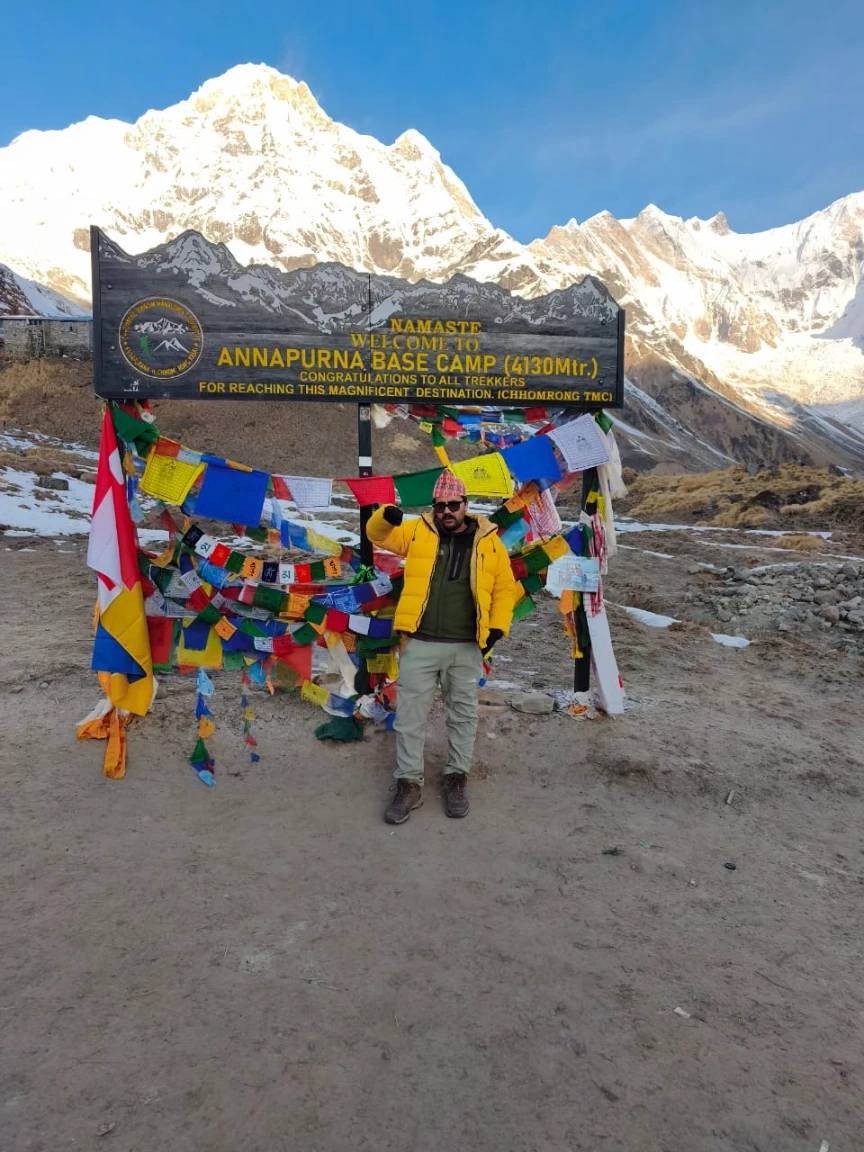
My Guide for the trip: Santosh Wagle at the Annapurna Base Camp
The final wordings of my whole journey is that despite those sore legs, steep stairs, and long days, the moment of the Annapurna Base Camp trek was all worth it. The splendid mountain views, the friendship built along the trail with Santosh and Bijay, and the observation of those cultural and natural gems were all magical.
If you want a trusted team to guide you, I highly recommend Nepal Vision Treks. Their care, experience, and support made my journey smoother and more meaningful. They truly know how to make the trek not just a hike but a life-changing adventure.
FAQ